

Dashboard
The dashboard is your personal workspace in nmrXiv. Upon logging in, you'll land on this page where you can view, manage, and organize all your projects, spectra, and compounds. The dashboard provides a centralized hub for accessing your research data and managing your submissions.
Dashboard Layout
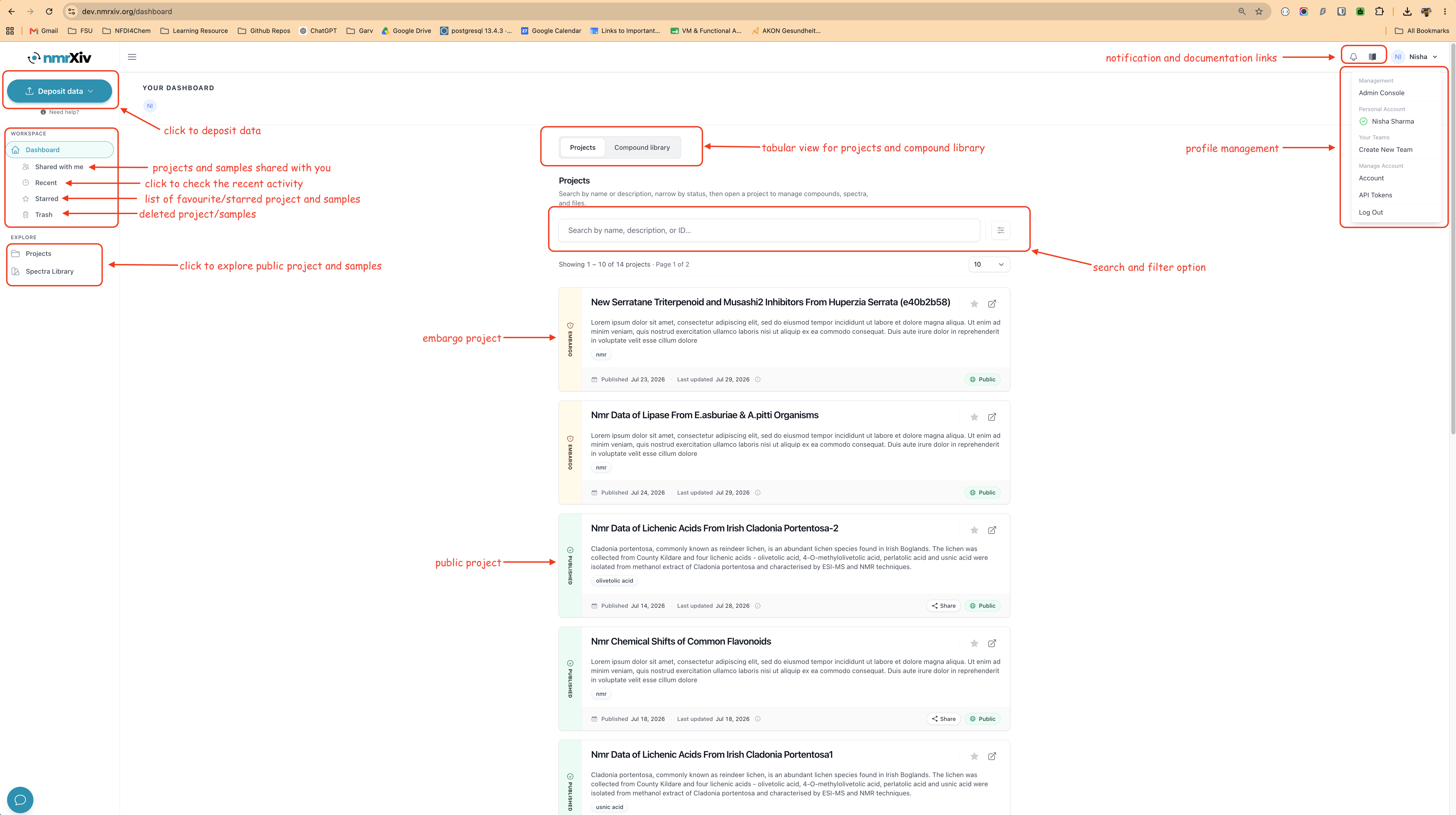
The dashboard is organized into three main areas:
Left Sidebar Navigation
The left sidebar provides quick access to different views and features:
Main Views:
- Deposit Data - Quick action button to start a new submission (Publication Deposition or Community Contribution)
Your Workspace:
- Shared with me - Projects shared with you by other nmrXiv users. See Sharing for more details.
- Recent - Your recently updated projects, for quick access to active work
- Starred - Your favorite projects, marked with a star for quick bookmarking
- Trash - Deleted projects that can be restored within the 30-day deletion grace period
Browse Public Data:
- Projects - Browse all public projects contributed by the community
- Spectra - Browse all public samples/spectra from community contributions
- Compound - Browse the compound library, organized as a reference collection of all molecules from published data
Projects Tab
The main dashboard area shows your projects with filtering and search capabilities. This tab displays a list of all your projects (both private drafts and published projects), where each project is shown as an individual card containing the project title, description, publication status, dates, and action buttons. You can search by project name or description, filter by status (All, Draft, Published, Archived, or Embargo), and manage your projects directly from this view.
Filtering and Searching
Search: Use the search box to find projects by name, description, id or keywords.
Status Filter: Filter projects by publication status:
All Status- Show all projects regardless of statusDraft- Show only private draft projectsPublished- Show only publicly published projectsArchived- Show only archived projectsEmbargo- Show only projects currently under embargo (scheduled for future release)
Compound Library (Spectra Tab)
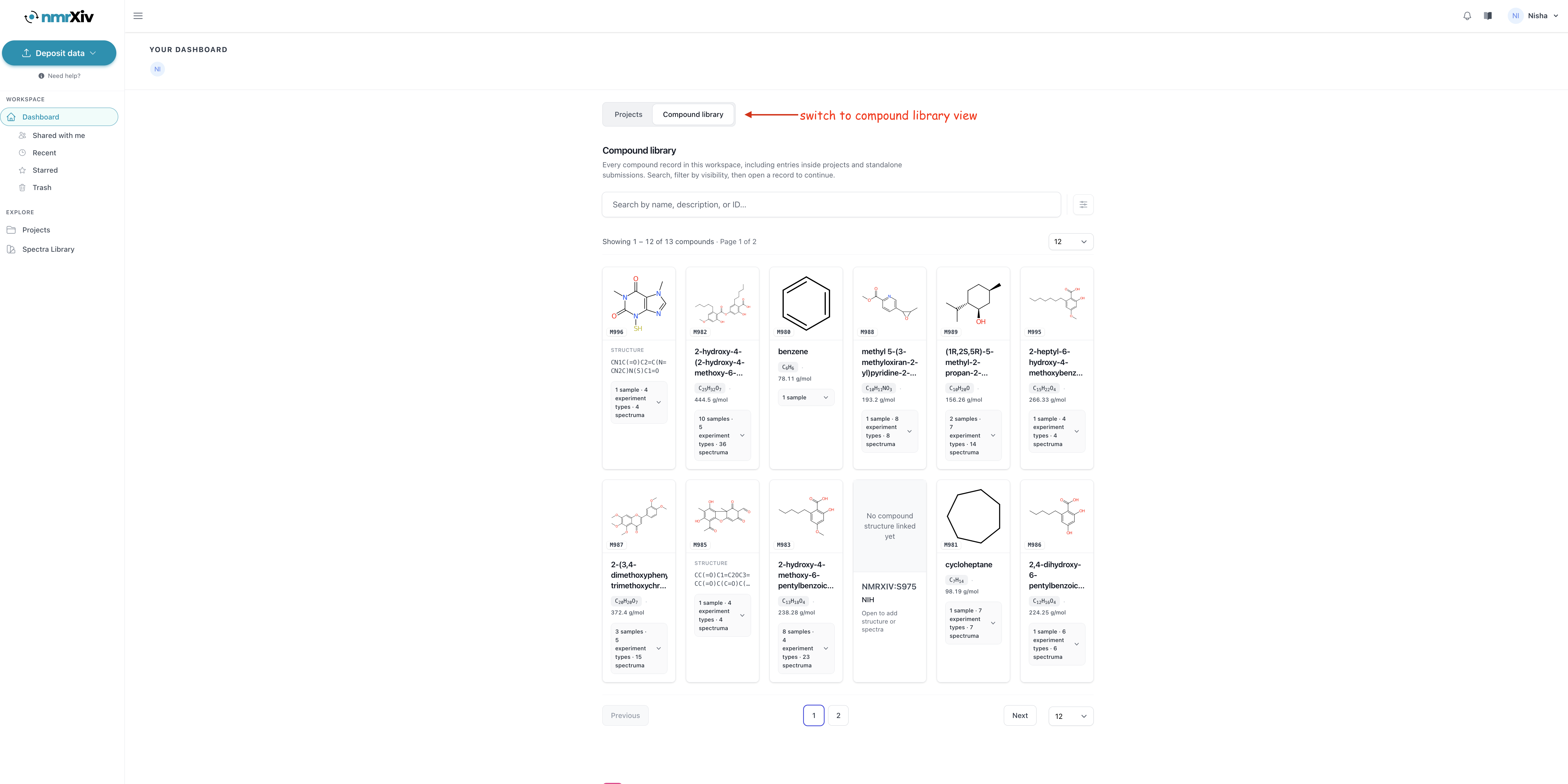
Switch to the Spectra tab to browse the public and private compound library and samples. This tab displays all compound records in this workspace, including entries within projects and standalone submissions. The compound library is organized as a reference collection showing individual compound cards with molecular structures, chemical information, and associated NMR datasets. You can search by compound name or formula and explore all spectra and metadata for each compound.
Compound Cards
The compound library displays compounds as individual cards, each showing:
- Compound Structure - A visual representation of the molecular structure
- Compound Name - The IUPAC name or common name
- Molecular Formula - The chemical formula
- Number of Datasets - How many NMR experiments are available for this compound
- Project Source - Which project(s) the compound appears in
Filtering and Browsing
Search: Use the search bar to find compounds by name, description, or compound ID.
Visibility Filter: Filter compounds by their visibility status:
All- Show all compounds regardless of visibilityPublic- Show only compounds from published public projectsPrivate- Show only compounds from your private draft projects
Viewing Compound Details
Click on a compound card to:
- View all datasets and spectra for that compound
- See projects that include this compound
- Access the NMRium viewer for interactive spectrum analysis
- View the compound structure in detail
- Download spectral data and associated files
Workspace Views
Shared with Me
Projects that other nmrXiv users have shared with you appear here. You can:
- View shared project details
- Add shared projects to your Starred collection
- See who shared the project with you
For detailed information about sharing, see Sharing.
Recent
Your most recently updated projects are listed here, making it easy to continue work on active submissions.
Starred
Projects you've marked as favorites appear here. Star a project by clicking the star icon on the project card to quickly bookmark important projects.
Trash
Deleted projects appear here for 30 days before permanent deletion. You can:
- Restore a project to return it to your active workspace
- Permanently delete a project (this action cannot be undone)
- View project details even while in trash
Managing Your Workspace
Creating a New Submission
Click the Deposit Data button at the top left to start a new submission:
- Choose between Publication Deposition (for publication-linked data) or Community Contribution (for standalone reference spectra)
- Follow the submission wizard to upload files and add metadata
Organizing Projects
Star projects for quick access to frequently used submissions.
Search and filter to quickly locate projects by status, name, or other criteria.
Navigate between tabs to browse different views (Projects, Spectra/Compound library).
Before Publishing
Remember: Once a project is made Public, all information becomes read-only and cannot be edited. Therefore:
- Review your metadata carefully before publication
- Check structure files and sample details
- Verify authors, citations, funding references and license information
- Confirm your release date and embargo settings if applicable
After Publication
Once public, your project:
- Becomes searchable in the public Projects tab
- Is included in the public compound library
- Receives a DOI and persistent identifier
- Can be cited and referenced by others
- Includes interactive NMRium spectra for analysis
- Remains associated with your account for recognition
INFO
Tips and Best Practices
- Keep drafts organized by giving meaningful project names
- Use starred projects to track active submissions
- Check Recent to quickly resume work on ongoing projects
- Use search and filters to manage large numbers of projects
- Review before publishing to ensure data quality and completeness :::